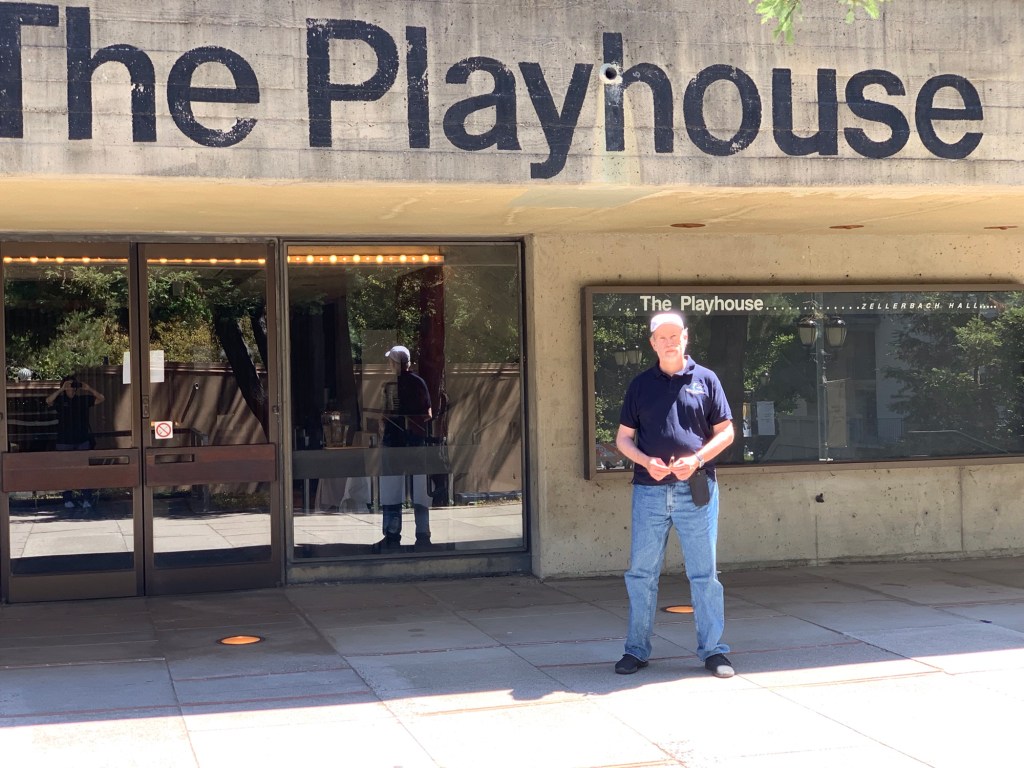
At Berkeley, we had a summer lunchtime theatre series. Each show rehearsed for two weeks (one week in the morning, one week in the afternoon) and then a week of performances. I directed two shows in two summers: Noel Coward’s We Were Dancing (in the Durham Studio Theatre) and Shakespeare’s Love’s Labour’s Lost—which I cut down to 52 minutes—in the Zellerbach Playhouse.
One day for the latter show, a woman dressed like a Berkeley gypsy (thrift store chic, but not too chic) arrived with a large group of Asian students. They sat near the front and seemed to really enjoy the show, laughing and nodding along.
When the show ended, one of our students, acting in the capacity of usher, came up to me and said this woman had made arrangements for the director to come talk to her students. I hadn’t heard about this, and I’ve assumed to this day that she had made no such arrangement, and that she invented it to give her students some value added to their experience. I was game to play along. So I walked to the front of the Playhouse, introduced myself, and asked if they had questions.
The discussion, which I believe was entirely prompted by the gypsy instructor, is lost to my memory. I do recall that it was brief and painless. She thanked me and, as her students began to file out, approached me. “Thank you for your time,” she said. “This is for you.” She placed a purple crystal in my palm and left with her group.
I still have that crystal somewhere.
 MUSOFYR