How do significant life events or the passage of time influence your perspective on life?
Warning: Math Alert!
I’ve often heard the question, “Why does time seem to go so slow when we’re kids but so quickly when we’re older?” While pondering this a few years ago, I arrived at a possible answer.
At the start of our lives, each minute, every hour, is still a large portion of our lives. Consider that a newborn baby at 1 day old has only lived for 24 hours. (I mean outside the womb; I’ll leave that “When does life start?” debate for others to chew on.) And so each hour is only 1/24th of their lives, and there have only been 1440 minutes of time passed. Each minute and hour, therefore, is a long time in comparison to the entire life lived so far.
But as we age, and have accumulated more minutes, hours, days, and then years, each of those measures of time is a smaller segment of our overall existence. On that first day, each minute was 1/1440th of a life; at age 30 each minute is 1/16,425,000 of a life. Our perception, relatively, tells us it’s much smaller.
I’ve occasionally suggested that when a physicist says, “The Math proves the existence of XYZ, even though we can’t see XYZ,” I wonder if the math really proves only the math. I’d make a cynical physicist. So I offer my equation here as only a suggestion and an idea to be pondered and discussed.
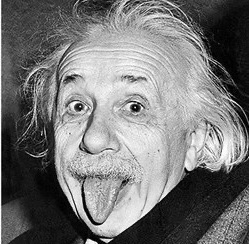
I wonder what Einstein would have to say?
 MUSOFYR
The Universe is accelerating.
LikeLiked by 1 person