Years ago, I found an online web-based chat site called BananaChat. This was one of the first of its kind. You would sign in, create a username, and chat on The Balcony. If you wanted a private chat you could “go to another room”—but as I recall, everyone on The Balcony could read your interactions, so you needed to create a private room.
I met some very cool people, including one (now known as Debi Latte in Second Life) whom I am still in contact with. We had a great time, and I am detailing some of this in my Digital Tech Memoir, a slowly-evolving piece I’ve been working on. As I explain there:
“One day BananaChat just disappeared, and I could no longer meet up with my online friends. This made me very angry and I somehow found the email address of the company who hosted the site and I sent a scathing email, demanding they reinstate the chat. They actually answered (something that would be rarer today, if you could even find contact information for a company/service) and said, “We don’t make any money from it, and we have no desire to continue offering the service, so it’s gone. Permanently.” And that was it. There were other chat options at the time, but BananaChat really was one of a kind.
“The reply I received taught me an important lesson. They said, in no uncertain terms, that they were offering a free service and if they felt like no longer offering it, that was their right. And, while I hated that response, I had to accept that it was totally valid. We lost BananaChat—and I gained a new insight into the digital world.”
At that same time, I was doing a lot of work with Apple’s HyperCard. According to Wikipedia, “HyperCard combines a flat-file database with a graphical, flexible, user-modifiable interface. HyperCard includes a built-in programming language called HyperTalk for manipulating data and the user interface.” (You can read the rest of the article, if you’d like.) It was easy to create a “stack” of cards with information to be presented, such as we see with PowerPoint or Keynote today. I used it quite successfully in my teaching, and its graphics and speech capabilities were very useful.
However, when Apple created System X, HyperCard no longer functioned, and I had to find alternatives. I played with webpages, and then later capitulated and moved to PowerPoint. (I often cited “Death by PowerPoint as an unfortunate side effect of meeting presentations.) I continued to use PP until my retirement. But sometimes, on older hard drives, I see an icon marked “exe” that is likely one of the no-longer functional HYperCard stacks.
And I had many of them.
That brings us today to TikTok.
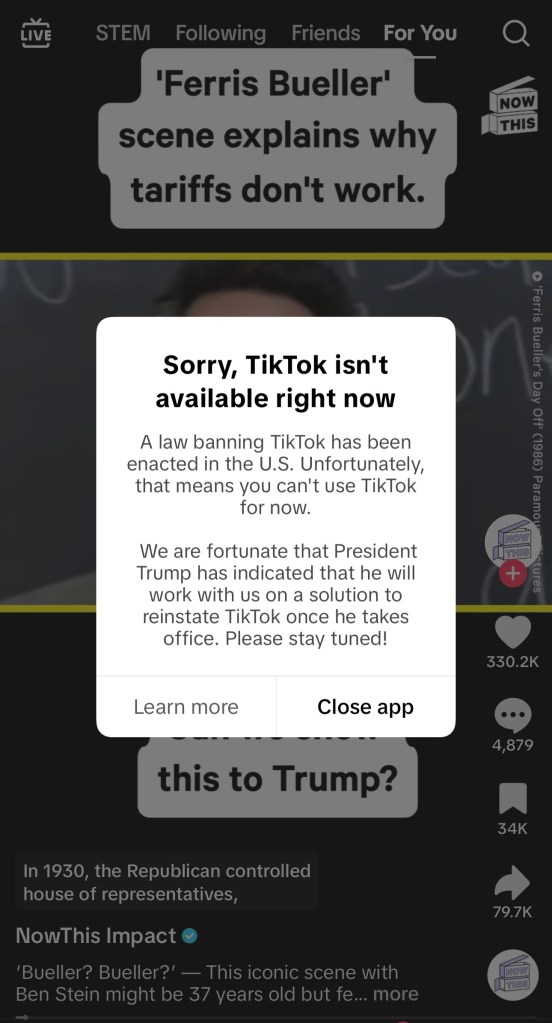
A little while ago, while writing his entry, I saw a notice on my phone that TikTok might be back, though mine is telling me I have no internet connection, which seems to be untrue, and not connecting.
But after the previous experiences I outlined above, I have no real strong emotional response about this. If TikTok does go away permanently, we’ll find an alternative, and shrug this off.
 MUSOFYR