The itinerary lists Yorkshire Dales National Parks, Lake Windermere, and Gretna Green: all part of the whirlwind driving-around from place to place in a bus. Add in that we were in the back of the bus today so Joyce would have a place to lie down across the long back seat since she was still feeling the effects of the intestinal mess that she was experiencing. So I saw these places and they were nice but was a bit preoccupied.
For the evening, after entering Scotland, we were scheduled to visit the Glasgow Cathedral, where a piper would lead us to dinner across the street. Joyce told me to go on without her, and she’d stay in the hotel. This is how I got to experience haggis.

Okay, so I have to ask what the big deal really is. Haggis is, according to Wikipedia, “a savoury pudding containing sheep’s pluck (heart, liver, and lungs), minced with onion, oatmeal, suet, spices, and salt, mixed with stock, and cooked while traditionally encased in the animal’s stomach though now an artificial casing is often used instead.” And when brought to your dining area, it looks like this:
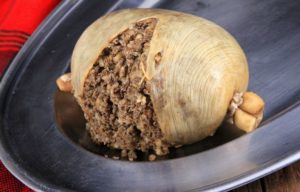
There was much consternation: who would take the haggis challenge? Who would dare eat it? Would it come to life and kill us? Okay, I made up that question based on the other two, because it didn’t seem like a big deal to me, for several reasons:
- Other people have eaten haggis for centuries and survived. Scotland persists. It can’t be that bad.
- Growing up in Pennsylvania Dutch country, I ate two dishes that might have similarities. One was “hog maw,” or pig stomach, with sausage, onions, and potatoes cooked inside a pig stomach. The other was scrapple which, according to Wikipedia, “is typically made of hog offal [also called variety meats, pluck or organ meats…the internal organs of a butchered animal], such as the head, heart, liver, and other trimmings, which are boiled with any bones attached (often the entire head), to make a broth. Once cooked, bones and fat are removed, the meat is reserved, and (dry) cornmeal is boiled in the broth to make a mush. The meat, finely minced, is returned to the pot and seasonings, typically sage, thyme, savory, black pepper, and others are added. The mush is formed into loaves and allowed to cool thoroughly until set.” Does that sound much different than haggis?
So I ordered it, and it arrived on my plate as a meatball next to the other food. Trying it, I found it was meaty and spicy. Not distasteful, not really something I would go out of my way to have again, but something to experience once. So I did; that’s what travel is partly for, isn’t it?
On the way back to the hotel I solicited help from my fellow passengers for Immodium and electrolyte replacement tablets for Joyce. These would help her get back on track almost immediately for….Day Four.
 MUSOFYR